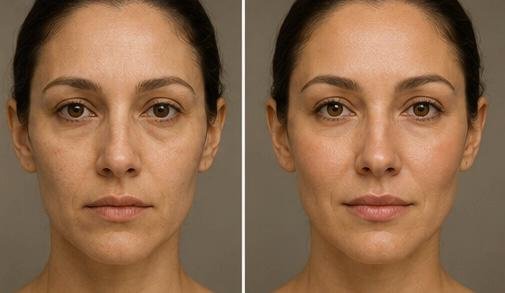
There is a quiet elegance to a youthful face.
It isn’t defined by perfectly smooth skin or exaggerated contours, but by gentle transitions, soft curves and the natural interplay of light and shadow across the face.
As we age, it isn’t simply the skin that changes. One of the earliest and most significant changes is the gradual loss of facial fat. Areas that once reflected light beautifully begin to hollow, the cheeks flatten, the temples become sunken and the face gradually loses its youthful balance.
Facial fat grafting is one of the most powerful tools in modern plastic surgery because it restores what time has taken away—using your own living tissue.
At Magnum Opus, facial fat grafting is approached not as a volume-enhancing procedure, but as an art of restoration.
Understanding Facial Ageing
For many years, ageing was thought to be a problem of loose skin alone.
We now understand that facial ageing is a complex process involving the skin, ligaments, bone and, importantly, the fat compartments that provide youthful support.
As these fat compartments shrink and descend, the face begins to appear tired, hollow or less vibrant—even in otherwise healthy individuals.
This is why simply tightening the skin often isn’t enough.
Sometimes, what the face truly needs is volume returned to its natural home.
What Is Facial Fat Grafting?
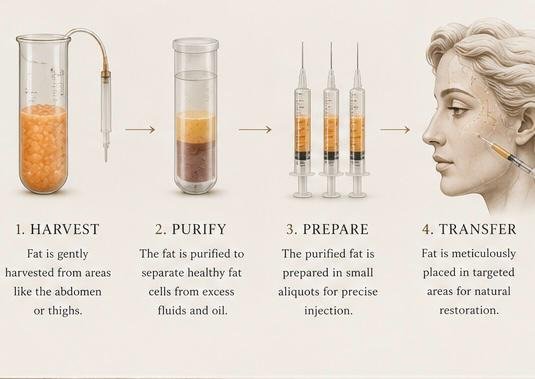
Facial fat grafting, also known as autologous fat transfer or lipofilling, involves transferring a small amount of your own fat from one part of the body to areas of the face that have lost volume.
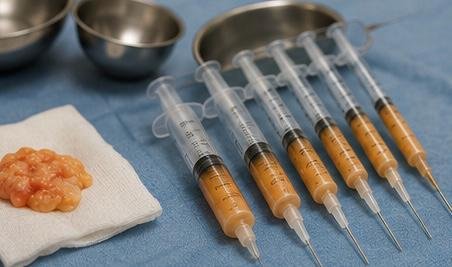
The fat is commonly harvested from areas such as the abdomen or thighs using gentle liposuction techniques.
It is then carefully purified to separate healthy fat cells from excess fluid, oil and blood before being meticulously reinjected into the face using fine cannulas.
Every tiny droplet is placed with precision.
Rather than creating obvious fullness, the aim is to recreate the soft contours that naturally existed years before.
More Than Volume Restoration
Fat is a remarkable tissue.
Beyond restoring contour, it contains regenerative cells that may contribute to improved skin quality, texture and overall tissue health.
Patients often notice that the treated areas appear healthier and softer over time, giving facial fat grafting a unique advantage over many synthetic fillers.
It is both restorative and regenerative.
Areas That Can Be Treated
Facial fat grafting can be used to restore volume in several areas, including:
- Temples
- Cheeks and midface
- Under-eye hollows
- Nasolabial folds
- Jawline
- Chin
- Lips
- Marionette lines
- Areas of facial asymmetry
- Depressed scars
The treatment plan is always individualised, as every face ages differently.
The goal is not to make every face look the same—but to restore each person’s natural proportions.
Fat Grafting vs Dermal Fillers
Both fat grafting and hyaluronic acid fillers have an important place in facial rejuvenation.
Fillers are an excellent non-surgical option for subtle refinement, contouring and treating smaller areas of volume loss with minimal downtime.
Fat grafting, however, offers several unique advantages:
- Uses your own tissue
- Can restore larger areas of volume
- May provide long-lasting improvement
- Offers regenerative benefits to the skin
- Creates exceptionally natural softness and movement
The best treatment depends on your anatomy, your goals and whether you are looking for temporary enhancement or longer-term restoration.
In many patients, the two techniques complement one another beautifully.
The Art of Fat Placement
One of the greatest misconceptions about fat grafting is that it simply involves injecting fat into the face.
In reality, successful fat grafting depends almost entirely on precision.
Tiny parcels of fat are carefully layered within different planes of the face to maximise survival while preserving natural facial movement.
Too much fat in one area may create fullness without elegance.
Too little may fail to achieve meaningful rejuvenation.
The artistry lies in understanding facial anatomy, recognising how ageing affects each individual, and restoring volume in a way that is invisible to everyone except the patient.
Recovery
Following facial fat grafting, it is normal to experience swelling and bruising for the first one to two weeks.
Because a small percentage of transferred fat is naturally reabsorbed during healing, treatment is planned with this process in mind.
Final results continue to evolve over several months as the grafted fat establishes its blood supply and becomes part of the surrounding tissue.
The result is not a face that looks “done.”
It is simply a face that looks refreshed, well-rested and naturally harmonious.
Is Facial Fat Grafting Right for You?
You may be a suitable candidate if you:
- Notice hollowing of the cheeks or temples
- Have under-eye volume loss
- Feel your face appears tired despite adequate rest
- Prefer using your own tissue rather than synthetic products
- Are undergoing other facial procedures and would benefit from volume restoration
- Desire natural, long-lasting facial rejuvenation
A detailed consultation allows us to assess facial structure, understand your aesthetic goals and create a personalised treatment plan.
A Thought to Leave You With
The most beautiful results in aesthetic surgery are rarely the ones that attract attention.
They are the ones that restore.
The face still looks like yours—only brighter, softer and more balanced.
Facial fat grafting is not about changing identity.
It is about returning the quiet confidence that comes when every feature exists in harmony once again.
Because true beauty is not created.
Sometimes, it is simply restored.